Overview
Accessible links (also known as hyperlinks) connect concise and descriptive text to a website or file. They make it easier for everyone to navigate and consume content.
This video shows how to create accessible links in PowerPoint, Word, and Outlook.
Use Links in Outlook
Clear and descriptive link text improves digital content for:
- Individuals using screen readers.
- Those who are neurodivergent.
- People with mobility challenges.
- Voice-control-software users.
About the Linked Text
When choosing linked text, keep accessibility in mind. Linked text that is optimized for accessibility is:
- Descriptive.
- Concise.
- Unique.
- Visually distinct.
Link text should clearly communicate the purpose of the link. Screen-reader users can navigate through a list of links, so the text must make sense when read on its own.
Unclear description
When directing a reader to Appendix 1 and using the words Click here, it is unclear where the reader is being taken.
A better option
Instead, use meaningful text, such as Read Appendix 1, which clearly states where the reader is being taken.
Link text should be brief and meaningful. Long link phrases can be hard to read visually and challenging to understand when announced by screen readers. In most cases, a few well-chosen words are sufficient.
Example: Read Appendix 2
Two or more links with the same text can introduce confusion, especially if they link to different resources.
Another reason why linking the words Click here or Learn more that go to different websites or documents is not accessible.
If you are linking to the same source, it is best to use the same linking language.
Linked text must be easy for sighted users to identify. By default, the Outlook displays links in blue, which provides strong contrast against standard black text on a white background.
Use Outlook’s built-in tools to make your links accessible.
Add a Link in Outlook
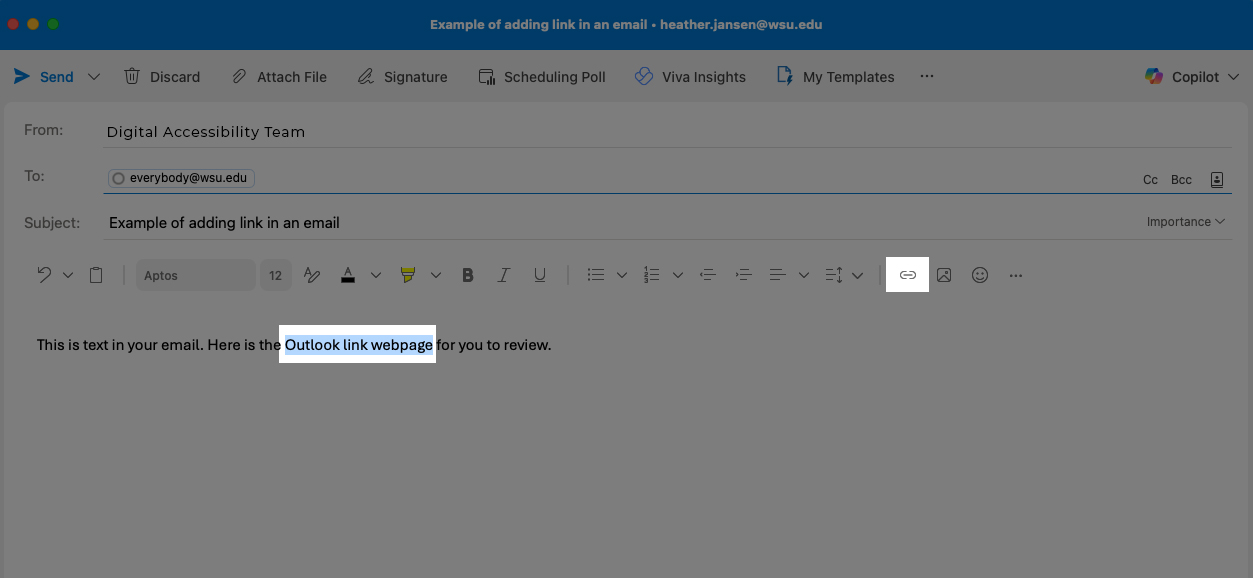
- Highlight the text that will become the link. Your screen may look slightly different, but highlighting the text is the same for Windows or Mac computers.
- Then, tap the Link button. If you don’t see the Link button, tap the Ellipsis button to see the rest of the menu.
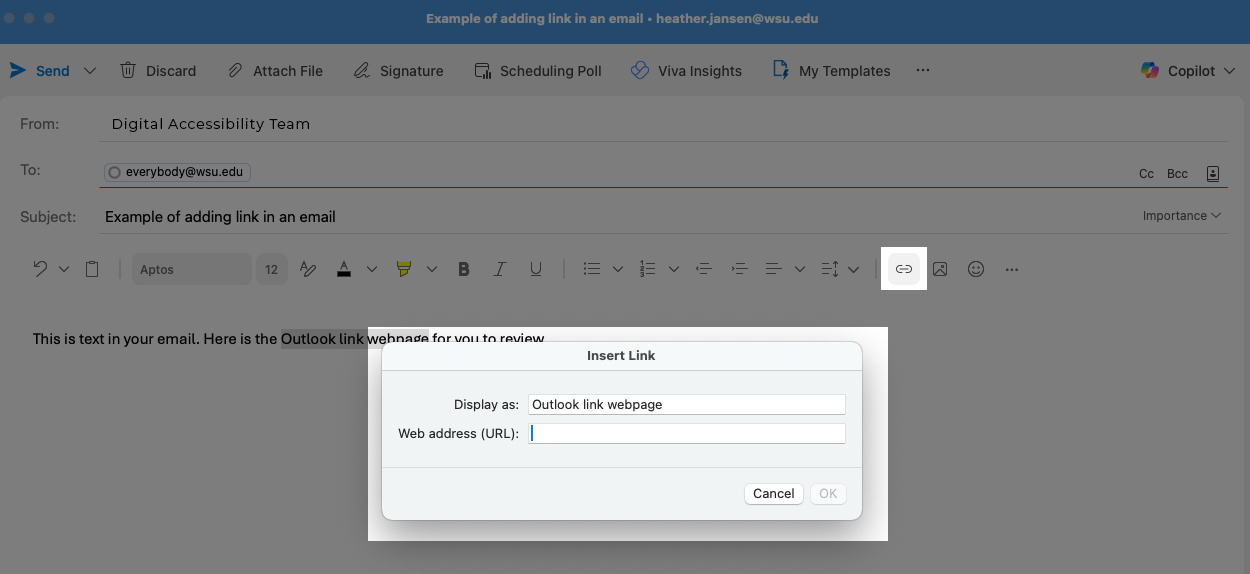
- Once you tap the Link button, a Popup window will appear for you to place your link.
- Add your link and tap OK.
Best Practices
- Use the built-in Outlook tools to make your emails accessible.
- Use clear and concise language for link text—no more than a few words.
- Use unique and meaningful link text that describes the link destination and can be understood out of context.
- Use the same link text when linking to the same destination.
- When links go to files or other digital formats, include the digital format in the link. Example (not an actual link): Core Concept Check Sheet
- Do not use a URL (https:// web address) as the link text.
- Do not underline text in Outlook emails. Underlining should be reserved for links.
- Do not use vague language in your links. Example: Click here or Learn more.
FAQ
Accessible hyperlinks ensure that people using screen readers, keyboard navigation, or voice control can understand where a link goes and decide whether to activate it.
Everyone benefits, but especially:
- Users of screen readers.
- Users with cognitive disabilities.
- Anyone scanning content quickly.
Screen-reader users may hear Click here or the entire URL with no context, making content confusing and unusable.
No. Screen readers often list links out of context, so Click here provides no meaningful information.
Yes. Multiple links with the same text but different destinations are confusing for assistive technology users.
However, if you have several links that go to the same destination, use the same link text.
Screen readers navigate directly from link to link and may present links as a list, separate from surrounding text.
No. Sometimes screen readers read links out of context without the nearby explanatory text.
Yes. Keyboard users often tab through links, so clear, descriptive link text is essential.
Microsoft Outlook creates functional links, but it does not ensure the link text itself is accessible, which is up to the author.
Yes, as long as each link is clearly described and distinct.
If there is more than one link in a sentence, you may want to consider adding a bulleted list with links instead.
Using vague link text like Here, More, or Download.
Be descriptive, clear, and concise with your link text.
Need assistance?
Contact the College of Medicine Digital Accessibility Team if you have questions or need one-on-one support or additional training.
Contact the Digital Accessibility Team